
Christmas with the OSO
PROGRAMME
A Christmas Festival
Leroy Anderson
Overture to/de Die Fledermaus
Johann Strauss II
Violin Concerto in F minor
“Winter” from The Four Seasons
I. Allegro non molto
II. Largo
III. Allegro
Hanna Williamson, solo violin
Antonio Vivaldi
Milles regretz
Josquin des Prés
December (Christmas) from The Seasons, Op. 37a
Pyotr Ilyich Tchaikovsky
The Nutcracker Suite
1. Overture
2. Toot Toot Tootie Toot (Dance of the Reed Pipes)
3. Danse of the Floreadores (Waltz of the Flowers)
4. Sugar Rum Cherry (Dance of the Sugar-Plum Fairy)
5. Peanut Brittle Brigade (March)
TCHAIKOVSKY arr. Duke Ellington & Billy Strayhorn, adaptation: Jeff Tyzik
Rudolph the Red-Nosed Reindeer
Johnny Marks arr. Jack Bullock
MUSICIANS
David Thies-Thompson, Conductor
VIOLIN 1
Hanna Williamson
Galina Rezaeipo
Alana Gralen
Aaron McFarlane
Kirsten Waymann
Luigi Torres
Erika Castillo
Anita Hiradhar
VIOLIN 2
Sarah Williams
Jennifer Francis
Micheline Kinsella
George Stathopoulos
Cathy Beehan
Carolyn Ho
Alla Perevalova
VIOLA
Emily Kistemake
Gunnar Foerstel
Ryan Vis
Caren Abramoff
Benjamin Thomas Johnson
Laurence Laforest
CELLO
Anthony Bacon
Erin Pickering
Olena Gapey
Natalie Wong
Grace Snippe
BASS
Anthony Bacon
Erin Pickering
Olena Gapey
Natalie Wong
Grace Snippe
FLUTE
Lara Deutsch
Pascale Margely
Annie Noël-de-Tilly
OBOE
Susan Butler
Marat Mulyukov
CLARINET
Shauna Barker
Roxanne Léveillé
Richard Paige
BASSOON
Ben Glossop
Orlando Corabian
HORN
Nigel Bell
Jennifer MacDonald
Cresta deGraaff
Michel Levasseur
TRUMPET
Travis Mandel
Lynn Patterson
Alexandre Rocheleau
TROMBONE
Léonard Pineault-Deault
Éric Vaillancourt
Leonard Ferguson
TUBA
Martin Labrosse
Saxophone
Victor Herbiet
TIMPANI
Ralph O’Connor
PERCUSSION
Dominique Moreau
Hugo Cayen
Alex Young
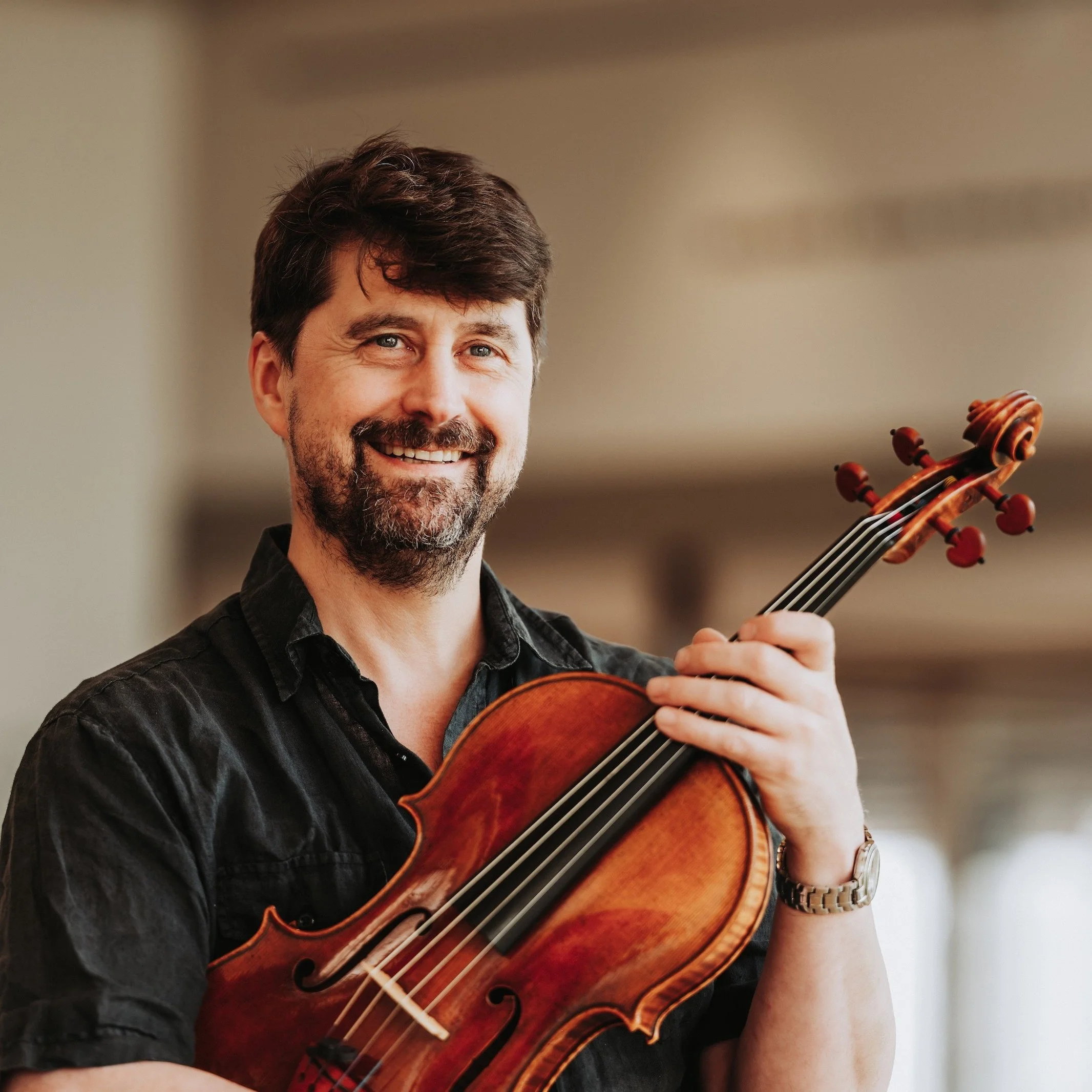
David Thies-Thompson
Conductor
-
Violist/Violinist/Conductor David Thies-Thompson has been a member of the National Arts
Centre Orchestra since 1990. His formative teachers included Sydney Humphreys and Mauricio
Fuks, and Stuart Knussen for intensive orchestral studies. He received diplomas from the
Victoria Conservatory of Music (Victoria B.C.) and the Royal Conservatory of Music, furthering
his studies at the Los Angeles Philharmonic Institute, the National Youth Orchestra of Canada,
the Banff Centre, the Eastman School of Music and McGill University. His professional
orchestral life began at the age of 15 in the Victoria Symphony, and shortly thereafter, two
seasons with Symphony Nova Scotia. In 2008, after 18 years in the NACO’s violin section,
David felt the lure of the NACO viola section. Since taking up viola, David feels incredibly
fortunate to have been invited on numerous occasions to play as a guest violist with the Berlin
Philharmonic. He is an active chamber musician, currently exploring piano trio repertoire with
the Oxbow Trio, and has performed as a collaborative musician in festivals in the National
Capital Region and across Canada. As a conductor, David served as Music Director of the
Ottawa Chamber Orchestra for fourteen seasons, has conducted the NACO Players’ Association
Fanfair concerts for many years, and he has enjoyed a long affiliation with the Ottawa Youth
Orchestra Academy. As an instructor, David teaches privately and has taught at both of Ottawa’s
Universities, and at the NAC Young Artists and International Orchestral Studies Programmes. He
has given masterclasses for violinists and violists on tours of the NAC Orchestra across Canada,
the US and Mexico, the UK, Europe and Chinad orchestras on soundtracks for Aura (Montreal Notre-Dame Basilica, Paradise City (South Korea) and for Cirque du Soleil’s Land of Fantasy (Hangzhou, China).
Over the course of her career, she founded three music organizations dedicated to contemporary music: Prima Ensemble, Wild West New Music Ensemble and the Calgary New Music Festival.
During the 2024-2025 season, Maestra Léonard is returning to the Ottawa Symphony Orchestra and will conduct the première of Songs of the Drowning by Iranian-Canadian composer Roozbeh Tabandeh with Ensemble Paramirabo and Chants Libres.
Ms. Léonard was the first woman to complete a doctorate in orchestra conducting at University of Montreal. In 2012, she received the Canada Art Council’s Jean-Marie Beaudet award for orchestral conducting.
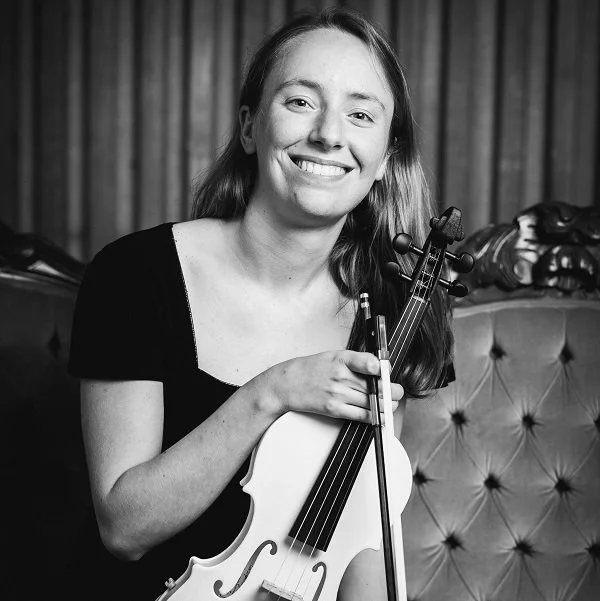
Hanna Williamson
Concertmaster, solo violin
-
Hanna Williamson works as a violinist and Reg Force member of the Canadian Armed Forces Serenade of
Strings piano quintet, providing music for government and military functions in the capital region. Since
enrolling in 2018, Hanna’s musical involvement outside the CAF has included co-directing the “Music in
Greenboro” concert series, subbing with the Ottawa Symphony and Kingston Symphony orchestras,
teaching with OrKidstra, and running a small private studio.
A native of Mission, British Columbia, Hanna Williamson began her post-secondary studies with Michael
van der Sloot at the Victoria Conservatory of Music after completing Performer’s ARCTs in both violin
and piano with Dr. Calvin Dyck, Dr Li-Ling Liao and Dr. Betty Suderman in her final year of high school.
She moved to Ottawa in 2014, completing her Master’s in Violin Performance with Yehonatan Berick
and Yosuke Kawasaki at the University of Ottawa.
Other music highlights have included travelling with the National Youth Orchestra of Canada (2012,
2015), attending ScotiaFest with the Happy Shephard String Quartet (2016), working with the National
Academy Orchestra (2016), summer tours with worship artist Fraser Campbell (2013-2017), and working
as a substitute with the Vancouver Metropolitan Orchestra and Vancouver Island Symphony.
Away from the office and violin, Hanna enjoys swimming, reading and painting! A recent commission is
featured on the cover of the Central Band of the Canadian Armed Forces most recent album “Heard –
Entendues”, released in 2024 under Captain Catherine Norris.
PROGRAMME NOTES
-
Antonio Vivaldi’s Four Seasons has become profoundly embedded in modern culture. Its strains are part of the sounds of modern life, heard on the radio and in department stores and elevators. There are perhaps 200 different recordings that can be purchased at the moment (reissues, anthologies, and excerpts make an exact count difficult), and it accounts for about half the 174 appearances Vivaldi’s music has made in movies and television, according to Internet Movie Database.
Yet in 1725, when Spring, Summer, Fall, and Winter were published as the first four concertos of his Op. 8 (the title “Four Seasons” was not used), they were viewed as crazy modern music, or facile curiosities, or tasteless gimmickry, or the way of the future, and pretty much everything in between. Antonio Vivaldi (1678-1741) was as controversial and polarizing a figure in his time as Beethoven and Wagner in theirs.
The feature of the Four Seasons that drew the most positive and negative attention when they were new was the one aspect that was largely ignored when, after two centuries of obscurity, they started to get played again in the 1950s and 1960s: their pictorial literalness. Vivaldi included a sonnet for each concerto explaining what was going on, supplying not just descriptions, but performance instructions. The sonnet verses are printed not only as prefaces to each concerto, but also in all the instrumental parts, in the midst of tempo and dynamic markings. This is something that can pass unnoticed by the modern audience, which consists of listeners who aren’t looking at the music on the page. But in Vivaldi’s day the audience for his publications consisted mostly of accomplished amateur players, who could play the Four Seasons with as many players as could gather around the part-books, or as few as six, as the highlight of a social gathering. They would have been keenly aware that the sounds they were making represented specific scenes.
Winter begins with shivering (in another remarkable chain of dissonances), chattering teeth and “running and stamping your feet every moment” to keep warm in snow and biting wind. The slow movement is a cozy fireside scene, “while the rain drenches everyone outside,” the raindrops in pizzicato under the solo violin’s melody. The finale begins by painting a picture of trying, not always successfully, to walk on ice without slipping, and concludes with the onslaught of “Sirocco, Boreas, and the other winds at war.”
Notes adapted from the LA Phil
Sonnets
Allegro non molto
"Aggiacciato tremar trà neri algenti
Al Severo Spirar d' orrido Vento,
Correr battendo i piedi ogni momento;
E pel Soverchio gel batter i denti;"
Largo
"Passar al foco i di quieti e contenti
Mentre la pioggia fuor bagna ben cento"
Allegro
"Caminar Sopra 'l giaccio, e à passo lento
Per timor di cader gersene intenti;
Gir forte Sdruzziolar, cader à terra
Di nuove ir Sopra 'l giaccio e correr forte
Sin ch' il giaccio si rompe, e si disserra;
Sentir uscir dalle ferrate porte
Sirocco Borea, e tutti i Venti in guerra
Quest' é 'l verno, mà tal, che gioja apporte."Winter – Concerto in f-minor
Allegro non molto
Shivering, frozen mid the frosty snow in biting, stinging winds;
running to and fro to stamp one's icy feet, teeth chattering in the bitter chill.
Largo
To rest contentedly beside the hearth, while those outside are drenched by pouring rain.
Allegro
We tread the icy path slowly and cautiously, for fear of tripping and falling.
Then turn abruptly, slip, crash on the ground and, rising, hasten on across the ice lest it cracks up.
We feel the chill north winds coarse through the home despite the locked and bolted doors…
this is winter, which nonetheless brings its own delights. -
No holiday concert feels complete without Tchaikovsky. While The Nutcracker remains a timeless classic, we offer an alternative this evening: December from The Seasons. Originally composed as a cycle of piano pieces, the work is heard here in an orchestral arrangement.
In 1876, Tchaikovsky was commissioned to write a short piece for each month of the year, to be published in the St. Petersburg magazine Nouvellist.
The Seasons consists of twelve pieces, one for each month of the year. Strictly speaking, the collection might more accurately be titled The Months, but the name under which it was published has endured, and so we accept it as such.
Each month reveals a distinct character. Some are intimate and lyrical, such as June’s Barcarolle and March’s Song of the Lark, while others, including November’s Troika and August’s Harvest, are more expansive and technically demanding. Yet across their varied moods and textures, all twelve unmistakably bear the musical voice of Tchaikovsky.
-
TCHAIKOVSKY arr. Duke Ellington & Billy Strayhorn, adaptation: Jeff Tyzik
Movements
1. Overture
2. Toot Toot Tootie Toot (Dance of the Reed Pipes)
3. Danse of the Floreadores (Waltz of the Flowers)
4. Sugar Rum Cherry (Dance of the Sugar-Plum Fairy)
5. Peanut Brittle Brigade (March)
The Christmas Eve setting of Tchaikovsky’s ballet The Nutcracker has helped it to become one of America’s most beloved Christmas traditions (we can thank the San Francisco Ballet of the 1940s), even though the composer had nothing of the sort in mind. By 1960, the potential appeal of updating Tchaikovsky’s score was obvious enough to a savvy musician like Duke Ellington.
Although separated by a century, the demands of the Romantic-era Russian ballet and the elaborate stage shows of New York City’s Cotton Club in the late 1920s presented similar challenges to Tchaikovsky and Ellington. The need for variety was paramount, meaning constant shifts in musical mood and style, but at the same time continuity was necessary. Exoticism was an audience favorite in both settings, and each composer had to take into account the choreography, making sure rhythms and tempos would allow the dancers to show their skills to the best effect.
The overtures in each case set the tone and show the range of timbre, volume, and articulation possible in each of their respective orchestras. Both are also elegant and balanced, whether in terms of the classicism that Tchaikovsky gleaned from Mozart and Haydn or the carefully calibrated swing of Ellington’s band. What typically follows in any concert performance of Tchaikovsky’s music is a selection from among the “characteristic dances,” which contrast style, tempo, and orchestration in order to conjure the various members of the court of the Sugar-Plum Fairy. As most conductors do, Ellington selected some, but not all, of these dances in order to show off the members of his band.
Ellington’s “Toot, Toot, Tootie, Toot” is the closest to its source material, although the innovations set the tone for what is to come. Where Tchaikovsky had piping flutes and bassoons over a quiet string ostinato, Ellington has the reed section divided into clarinets and saxes in close alternation, over a relaxed groove in the rhythm section, with more forceful interjections from the brass. The melancholy, resonant English horn solo becomes a series of broad smears with cup mutes in the trombones. Where the middle portion of Tchaikovsky’s dance is an exoticized whirling dervish, with trumpets over an ostinato in the low strings and brass, Ellington instead lets the band break out into an improvisatory section with the clarinet in the lead.
The two marches also make for an interesting comparison—similar in spirit but executed on their own terms. Tchaikovsky’s quick marche militaire is all about precision of articulation and brilliance in figuration and orchestration. Although the brightness of trumpet also figures in Ellington’s “Peanut Brittle Brigade,” the virtuosity shines through most clearly in a series of up-tempo, boppish solo choruses for trumpet, clarinet, tenor sax, and piano.
Tchaikovsky’s indifference to his own score for The Nutcracker is famous, but the “Dance of the Sugar-Plum Fairy” allowed him to showcase a new instrument that fascinated him—the celesta—making it perhaps the only part of the score he was pleased with. The twinkling, ethereal sound of the instrument, accompanied only by delicate pizzicatos, does make for a magical atmosphere—and it is here that Ellington and Strayhorn part ways with Tchaikovsky in all but the melody they borrowed. Over a slow vamp from the drummer, using the evocative toms, the tenor saxophone struts through “Sugar Rum Cherry,” encouraged by occasional smears and growls in the brass.
The blistering trepak of Tchaikovsky’s Russian Dance becomes the energetic bounce of the “Volga Vouty.” In another reversal, Tchaikovsky’s graceful, but somewhat melancholy and restrained “Waltz of the Flowers” becomes an opportunity for almost every member of the band to have a virtuosic turn in the rousing series of swing choruses that make up “Dance of the Floreadores.” —Katherine Baber, Ph.D., Professor of Music and Director of the Salzburg Program, University of Redlands
SPONSORS
Thank you to our partners & sponsors for making this event possible.








Administration
STAFF
Mathieu Roy, Orchestra Administrator
Vicente García, Personnel & Production Manager
Jacqueline Lee, Stage Manager
Michael Goodes, Front of House Technician
BOARD OF DIRECTORS
Bernie Etzinger, President & Chair
Tayler Farrellt, Corporate Secretary
Ada Kwok, Treasurer
Venassa Baptiste, Assistant Treasurer
Alexis Nickson, Director
Fiona Charlton, Director
Lara Deutsch, Musicians' Representative (Ex-Officio)
Jean-François Marquis, Musicians' Representative (Ex-Officio)
Ottawa Symphony Orchestra
(613) 231-7802 | info@ottawasymphony.com
Charity Registration #119071876RR0001
Do you like what you hear? Do you want to help support the arts in your community?
Donate to the Ottawa Symphony today to help support our programs. The cost of producing orchestral music is far greater than we could ever hope to make through ticket revenue. The OSO relies on funding from the government, foundations, and individual donors like you